
Major Setback for Ishwarchand Goyal and Sachin Goyal’s ‘Pristine’: NGT Imposes ₹12.45 Crore Environmental Compensation
Environmental violations found in three projects – Pristine Prism and Pristine Royal in Aundh among them; Developer directed to deposit compensation within two months
3 મિનિટ વાંચન
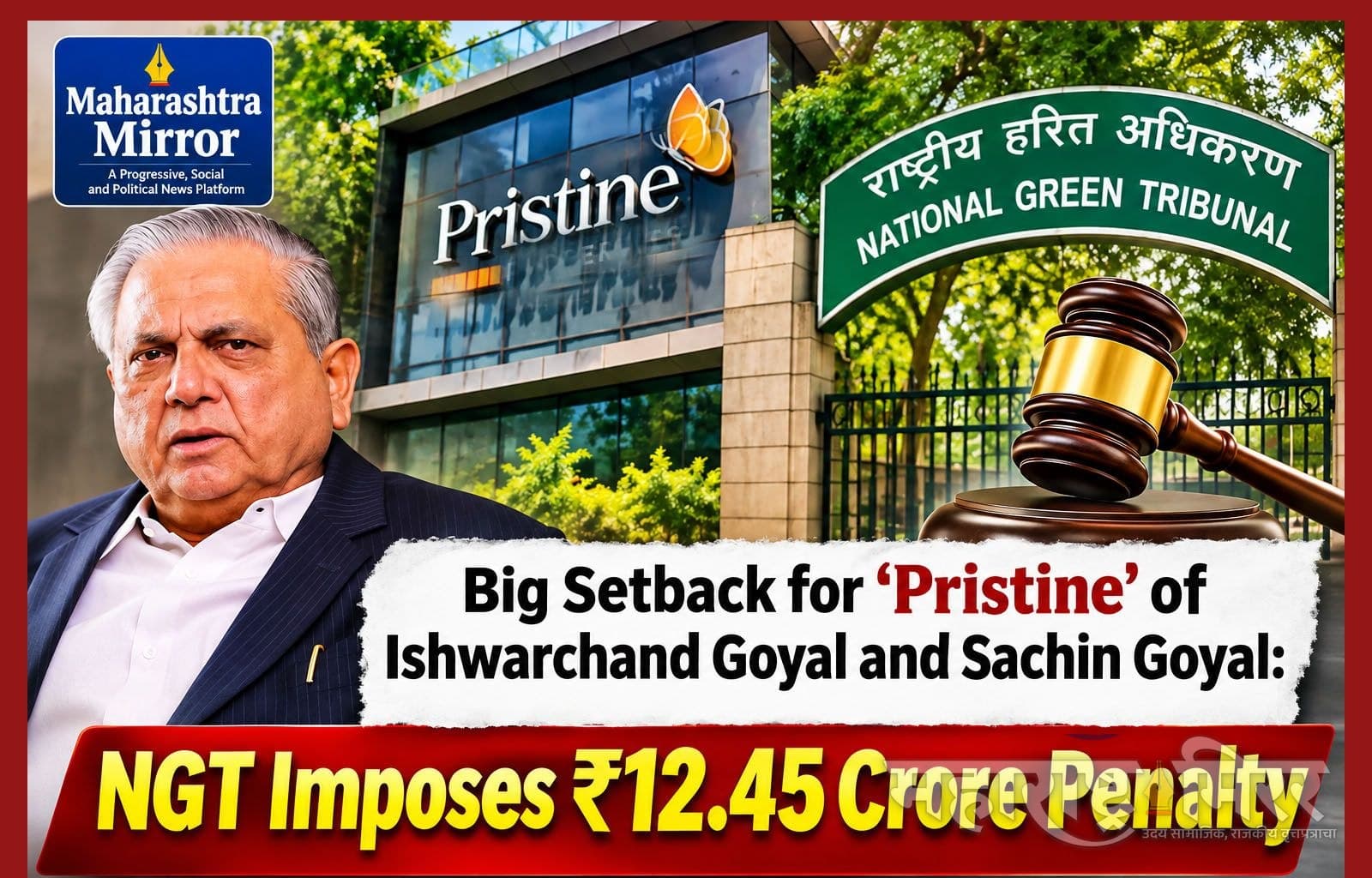
Pune, Maharashtra Mirror : The National Green Tribunal (NGT) has taken major action over alleged environmental violations in construction projects in Pune. The tribunal has directed Padmavati Associates, a Pune-based developer, to pay environmental compensation of ₹12,45,77,156.40 (₹12.45 crore) in connection with environmental violations at three residential projects — Pristine Prism, Pristine Royal and Pristine Privilege — in the Aundh area of Pune.
The amount must be deposited with the Maharashtra Pollution Control Board (MPCB) within two months. The ruling is being viewed as a major setback for Pristine, whose projects are associated with Padmavati Associates partners Ishwarchand Kishorilal Goyal and Sachin Ishwarchand Goyal.
In its order dated November 19, the NGT's Western Zone Bench observed serious violations of environmental regulations at the concerned projects. The tribunal highlighted construction activities allegedly carried out without obtaining the mandatory Environmental Clearance (EC), Consent to Establish (CTE) and Consent to Operate (CTO).
The tribunal also noted deficiencies in Sewage Treatment Plants (STPs), rainwater harvesting systems and the development of green belts. The projects are associated with Padmavati Associates partners Ishwarchand Kishorilal Goyal and Sachin Ishwarchand Goyal.
During the technical assessment of the projects, a report submitted by VNIT Nagpur reportedly found that two of the projects did not have sewage treatment plants and that water conservation measures were inadequate. The NGT also took these deficiencies into consideration while deciding the matter.
Environmental Compensation to Be Used for Ecological Restoration
The tribunal's order is not limited to imposing financial compensation. It has also issued directions for restoring the environment in the affected areas.
The Pune Municipal Corporation (PMC) has been directed to prepare an environmental restoration plan for the affected area in coordination with the Maharashtra Pollution Control Board (MPCB) and the Central Pollution Control Board (CPCB).
The compensation recovered from the developer will be utilised to improve environmental conditions in the affected areas and implement necessary remedial measures. Therefore, the action is significant not only from a punitive perspective but also in terms of ensuring compensation for environmental damage.
Questions Raised Over Environmental Clearance Procedures
The ruling has also brought the functioning of the State Environment Impact Assessment Authority (SEIAA), along with the approval and monitoring mechanisms for construction projects, under scrutiny.
The case highlights the need for effective verification of whether developers have obtained all mandatory environmental clearances before commencing construction, as well as timely action in cases of violations.
Against the backdrop of extensive construction activity in Pune, the NGT's decision is considered significant. The ruling reinforces the principle that compliance with environmental regulations is not merely an administrative formality but a legally binding responsibility.
It also sends a strong message that developers found violating environmental norms may face substantial financial compensation liabilities, along with the responsibility of restoring the environmental damage caused by their projects.